
I like using X-in-6 rolls to resolve things on fly when I’m GMing, particularly stuff for which there is no rule and for yes/no questions. I also love using oracle dice — in my case Rory’s Story Cubes — and tarot card pulls to answer questions and give myself inspiration on the fly. These sorts of tools are fabulously portable and are easily used in all sorts of games.
Which is why when I got to play Tales of Argosa [affiliate link] and our GM whipped out the bespoke oracle dice made for that game, I ordered a set of them that same night.
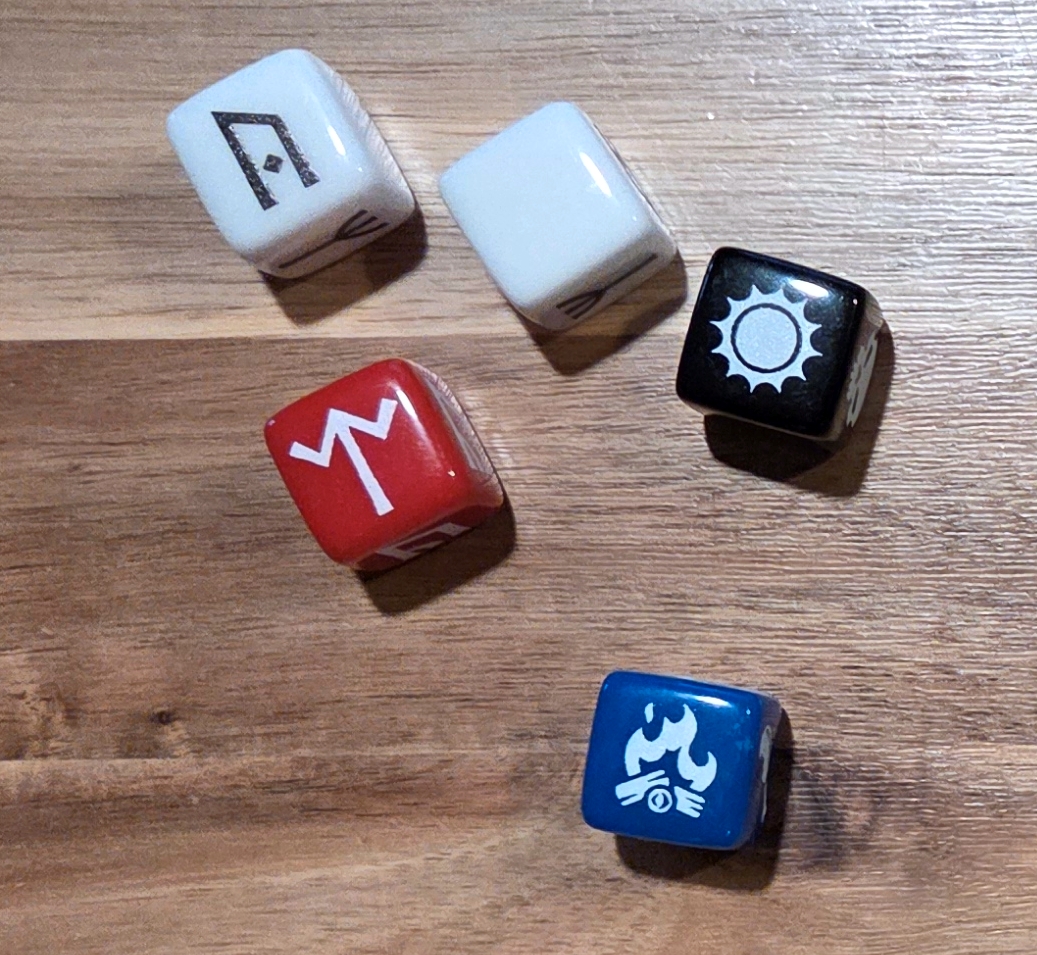
The playtest version of Tales of Argosa [affiliate link] is a free PDF, and it includes the rules for the oracle dice and the activity die. You can buy the dice on The Game Crafter for $22. The rules for the oracle dice take up one page, and ditto the rules for the activity die. I dropped those pages straight into my Traveller binder, since that’s the game I’m running right now.
Them bones
What makes these great is that instead of just yes/no, you get the classic improv-fueling variations — “yes, and,” “yes, but,” “no, and,” and “no, but” — as well as benefit/complication (which my brain always thinks of as weal/woe; thanks, D&D) and degree of yes/no, and you can adjust the likelihood of yes or no.
Where a 1d6 roll can give you binary yes/no (1-3 or 4-6), and it’s easy to adjust the likelihood of one outcome (yes 1-4, no 5-6), that’s about it. And that’s fine; I love that approach. But in exchange for a tiny bit of rules overhead, the ToA oracle dice are so much more interesting than that in play.
This is exactly the kind of loosey-goosey inspiration within constraints that I love using at the table. Not sure what would happen? Ask the dice. Every time our GM did that in our Tales session, the outcome was more interesting than a simple yes or no.
These dice also have flavor. The symbols are cool. Rolling them feels like a little ritual, one that engages the whole table whenever it’s performed.
That blue die
The activity die tells you what the monster or other random encounter is doing when you encounter it, like eating or working or fighting. There’s a little table of ideas, but even without it the symbols are enough to put some English on an encounter.
POD dice?
These dice are printed on demand, and the symbols are printed rather than etched. (Here’s some info on TGC’s process.) I might have balked at buying non-etched dice if it weren’t for these dice from my first gaming convention in 1992 or 1993. They spent 2/3 of their life in my dice box, avoiding the wear from rolling — although not the wear from rattling around with thousands of other dice — because they’re precious to me. But for the past 10+ years I’ve been carrying and rolling them because life’s too short to not use cool stuff.
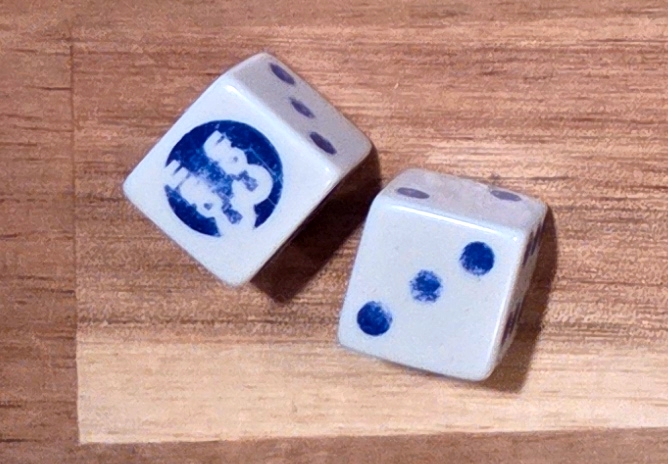
Are they starting to wear? You bet. But given their current rate of fading and wear, I’ll probably be dead before they stop being readable.
Tales of Argosa [affiliate link] is an excellent game. These oracle dice rock.
Ooo… Tales of Argosa looks like a game I’d like to play.
It’s right up your alley, John. I’d love to play it again.