
I mentioned last July that I wasn’t far enough into my group’s Traveller campaign to write a full blog post about it, but here in January after 9 sessions I feel better equipped to talk about how things are going. The crew of the Volitant-class Far Trader Neutrino Phoenix has been exploring the Cidrogal Subsector one Jump-2 at a time, and we’ve all been digging it.
TL;DR: Things are going well and this sandbox campaign is a lot of fun. You should try running a no-prep Traveller sandbox because it’s nifty.
Nota bene: If it matters, this is a Mongoose Traveller 2e [affiliate link] campaign. I also use books from previous editions because they’re great and the stats are close enough.
We’re currently using the rules as written. No real house rules, but the core book is silent on whether the PCs can split up to handle spaceport tasks like trade and rumor-gathering in parallel, and we say they can do that. We also came to a shared understanding about when passengers are available and a few other nitty-gritty trade-related things along those lines. Nothing major.
A quick mea culpa: This is an ongoing campaign and the other players might stumble across this post, so I’m not sharing any GM-facing stuff even if it would make this a better blog post. Sorry about that.
A snapshot of play
So much of this post turned out to be about setting up the campaign that I wanted to make sure I led with a look at how it actually, you know, plays.
- The PCs decide what to do that session. Their broad goals are “Find Ancient artifacts” and “Become financially independent.” They move cargo and passengers for the second one, and fly around to different planets for the first one. They can do, and do do, whatever the fuck they want, and go wherever they want within the sandbox. The game is about what happens at the table.
- I know what each faction in the sandbox wants, I know the themes of the subsector, and I know what the various NPCs (met or unmet) want; those are my foundation for improvisation.
- When it’s time for random encounter rolls, I make them. I interpret the results on the fly using a combination of my campaign notes, faction and NPC goals, in-game events, and my oracles (Rory’s Story Cubes and tarot cards).
- If I need stats, I pull them from Supplement 7: 1,001 Characters or I just assume that if someone is competent at something, they get a +1 or +2 and leave it at that. For patrons, I use Supplement 1: 760 Patrons. I use a rumor matrix (more on that below), and if an adventure is needed I use the generator from the core book [affiliate link].
- If “What happens next?” isn’t obvious from the game mechanics, that situation gets a pull from my tarot deck, a roll of a random small handful of Rory’s Story Cubes, or both (updated to add: or a roll of the Tales of Argosa oracle dice). Then I furrow my brow, look over my notes, and come up with something that fits the setting. I don’t worry about “balance” (a slippery slope in a sandbox), but barring unusual circumstances I forecast danger and avoid injecting life-threatening peril that wasn’t previously foreshadowed. “The world is the world,” so whatever I improvise has to make sense in the setting, but it won’t be a bespoke encounter precisely tailored to the PCs and their abilities because who has time for that shit and that’s not something I enjoy in any case.
- Most of the time, we share authorship of setting details. I came up with the foundation, and I keep narrative control over the places I want to be a mystery (because that’s fun for everyone), but the rest is often detailed through a freewheeling conversation at the table. We look at the library data — which the PCs have access to — and try to reconcile all the fascinating and incongruent elements that result from (lightly massaged) random system generation. (I’ve shared an example later in this post.)
- I ask a lot of questions. “What’s that place like?” “What’s weird about this guy?” “Tell me something surprising about this situation.” This comes from years of playing and running PbtA games, and it’s become a central and universal component of how I run games like this Traveller campaign.
- Sometimes the party arrives in a system with a plan. Sometimes they arrive, we hash out what the place is like, they make some rumor and patron rolls and wrangle cargo, and a course of action emerges. In case it’s not evident by this point, I don’t steer.
- And lastly, this group is 1) on board with this process, which was an integral part of my pitch, and 2) used to and good at shared authorship, yielding the spotlight, doing stuff that highlights other players’ characters, and pausing to talk through stuff until we’re sure everyone is on the same page.
I know this list has some big “draw the rest of the fucking owl” energy, but it is what it is. I’m trying to open a window into my weird brain, and into my group’s play, by drawing on half-remembered bullshit from six months ago (which ain’t getting any easier as I get older) and my scattered notes. It’s tough to distill all that into a useful, meaningful blog post.
I’ve done my best. It sprawls. It might not be in the most logical order. I’ve probably forgotten something important. It’s full of asides. I hope it helps you in your Traveller journey despite all that.
Keystones and touchstones
This campaign wouldn’t exist without these three amazing blog posts:
- The Tales to Astound! blog post TRAVELLER: Out of the Box–The Casual and Improvisatory Nature of Early Traveller Play and the Jeffro’s Space Gaming Blog post Classic Traveller and the Zero Prep Campaign Setting. I was curious if one could run Traveller with zero prep, and these two posts 1) showed me that one could, 2) made it sound like fun, and 3) revealed to me that Traveller was designed around improvisation at the table. This is where it all started clicking for me.
- On the Four Table Legs of Traveller, Leg 1: Mortgages, the first in Sir Poley‘s series of four Tumblr posts on the core elements of Traveller. Prior to starting this campaign, I’d only played two or three sessions of Trav over the years. I needed context, and those posts are awesome at providing context.
If you’re thinking about running a Traveller sandbox, stop reading my post and take some time to read theirs (and then come back!).
A huge thank you to the authors of Tales to Astound!, Jeffro’s Space Gaming Blog, and Sir Poley for bringing this campaign — a source of great joy — into my life, and for unlocking some of what makes Traveller such a special game for me.
Goals
I’m happy to do campaign prep, provided doing it means I can do zero (and no more than very little) session prep.
My main goal was to create a framework for a sandbox campaign which would require as little session prep as possible. This started with pitching the idea to my group, of course: Traveller in the classic mold, the PCs making their way in the universe, with random encounters, random subsector and planet generation, no prepped plots of any kind, dynamic factions with their own goals, and all the action being driven by the other players. (For more on this ethos, see my post There is no curtain.)
Apart from that, I really just wanted to create what in my mind is sort of the classic Traveller experience: The PCs have a ship, there’s a frontier subsector full of weird and interesting stuff, and they do whatever they feel like in that place.
To accomplish that I needed to use, gather, and/or create the tools to support that style of sandbox play. That’s what this post is about.
Setting
I created the Cidrogal Subsector for our game. It sits within the Foreven Sector, which is a sort of “GM’s preserve” that’s been deliberately omitted from canon Traveller products (for the most part). It’s analogous to Sembia in the Forgotten Realms: in a location significant enough for it to be an important place, with well-known and -detailed neighbors, but left out of D&D books so you can do whatever you like without having to rework other material to match.
This post unlocked how to approach Cidrogal for me: Foreven, What do You Want to See? And this Reddit post was helpful in thinking about how to start this process. At the end of the day, I just thought about what interested me and put it into the subsector.
Here are some of my notes from April 2025, when I started working on the subsector. They’ve been lightly edited to remove spoilers in case any of the other players read this post.
Build from what’s known, but make Foreven mine:
- Foreven is frontier space
- Plenty of Amber worlds, at least one or two Red worlds
- Zhodani Consulate is coreward, and wants to prevent the Imperium from expanding spinward into Foreven
- The Zhodani are the largest canon power in Foreven, controlling 7/16 of it
- Domain of Deneb in Five Sisters sector (trailing) is the nearest outpost of the Imperium proper
- The Far Frontiers region (spinward) is full of Imperial client states, which means the Imperium got there through Foreven
- If the Imperium wants to expand spinward of the Spinward Marches, which it seems to based on the existence of Five Sisters, then Foreven is a logical place to do that
The Cidrogal subsector includes:
- An Imperial client state
- Borders extend beyond the subsector
- An independent state that’s courting both the Zhodani Consulate and the Imperium
- Its borders also extend beyond the subsector
- Domain of Deneb (from Five Sisters, trailing) seeking to expand its influence spinward
- The Zhodani, both directly and indirectly
- Independent worlds, some of which are viewed as prizes by the other factions
- A corporation aiming to dominate trade with Five Sisters
- Pirates
- Which means Red worlds are a feature
- Proxy actions by the Zhodani and the Imperium
- Working through the two main states as well as the independent worlds
- That brings mercenaries and adventurers
- At least one 1-jump trade route connecting the subsector to Five Sisters
- The map shows a logical spot on the coreward and rimward ends (trailing side)
Sandbox framework
For my money, a sandbox needs a few things to work.
A call to adventure
This can be abandoned immediately (the story is what happens at the table), but it gives us all something to hang our hats on, a reason for the PCs to stay in the sandbox, and some toys to play with. I was intrigued by reading about the Ancients and their mysterious artifacts, so I went with that.
“Ancient artifacts were recently discovered in this frontier subsector, sparking a ‘gold rush’ as adventurers, mercenaries, and various factions get involved in searching for more of them.” Boom, done.
Factions
One of the other players, Pete, shared what turned out to be the key to making this whole sandbox Traveller thing click for me: the faction system from Mausritter. Mausritter is PWYW in PDF [affiliate link] and the faction rules are one page long. They’re brilliant.
You give each faction a name, goals, and resources. Between sessions, you take resources, PC actions, and faction actions into account and then roll for each goal to see if they made progress towards achieving the goal.
To that I added a high-level summary (e.g., “Sinister mining corporation now expanding into trade, Weyland-Yutani vibe“) and a concept from The Dresden Files: Our World [affiliate link]: faces. In TDF, the “face” is an iconic central NPC for each faction. If you want to interact with that faction, you most likely go find that person to get the ball rolling. The players know who the faces are.
Given that Dresden assumes you’re mostly playing in a single city, I stretched that a bit to accommodate Traveller’s much larger sandbox. Each faction got two faces:
- Someone high up in the organization, a driving force; not necessarily the Big Leader, but a leader
- Someone lower down in the ranks, more likely to be encountered while roaming the spaceways
Each of those NPCs got a one-sentence sketch that included a simple character trait and a concrete goal.
Each faction takes up about half of a printed page. I can easily see at a glance what they’re about, what they’re up to, and how things are going for them, and I have a ready reference for improvising stuff on the spot.
“Hey, we just rolled a random encounter. Given we’re in the X System, it probably involves Faction Y. The have lots of well-armed starships at their disposal, so it’s one of those ships. Who’s flying it? Let’s see who I jotted down — yep, it’s that guy.”
I don’t roll between every session. Some factions have goals that would take weeks or months to achieve. I also needed the PCs to at least learn about each faction before the faction moves would have meaningful impacts in play. So far I’ve rolled once or twice, so roughly every five sessions. It just depends how much in-universe time each session takes.
Faction template
While I can’t share any actual factions, here’s the template I use:
Faction name
Brief summary, ideally one line
Major goal, ideally one line
What they want:
– Immediate goal that can impact or be engaged with by the PCs
– Immediate goal that can impact or be engaged with by the PCs
How they’ll get it:
– Resource, actions, etc. – e.g., naval fleet, assassination, spies
– Resource, actions, etc. – e.g., naval fleet, assassination, spies
Faces:
– NPC who the PCs can interact with easily
– Higher-up NPC working on one or both “what they want” items
Interesting places
My first step was to use Zhodani Base’s random subsector generator. I set it to: pocket empires, backwater, scattered, rules book 6, no atmosphere fix.
I spun the wheel until I got one that had the vibe I was going for: dense enough to be full of places to visit, sparse enough to feel like the frontier, and with some I’d-never-have-planned-that clumps/clusters/choices.
Like any good random generator, this one produced some glorious stuff and some elements that needed work. The first pass had way too many lifeless ice-ball worlds. But other themes that emerged piqued my interest, so they stayed in. Ideas began to germinate.
Once I had all the subsector library data, I put it into a giant spreadsheet. It included a splash of GM-only info about every system, so I stripped that out and copied the spreadsheet into our shared drive for the other players to use.
When we come up with details about a system, I create a new tab and add them there.
Subsector map
I spent a lot of my campaign prep time on making the subsector map.
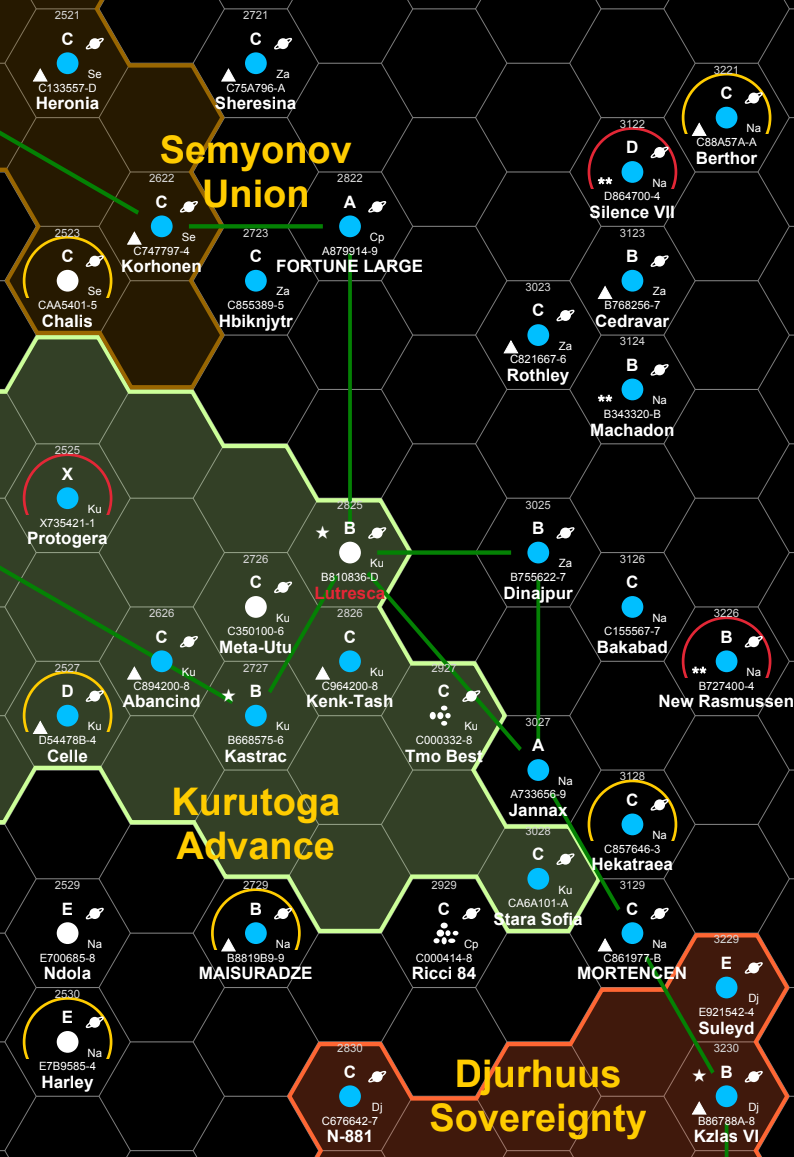
I started by exporting my subsector data to the absolutely amazing online tool The Traveller Map.
I tinkered with system names and other details, leaving some as they were and injecting some of my own personality and preferences into the randomness. I wanted a mix of system types, including at least a couple asteroid belts. Ditto with bases. Instead of a web of trade routes, which I felt would add visual clutter, I went with “main lines of trade and communication,” a simple network of jump paths. I had to learn The Traveller Map’s syntax for adding those, and borders, and so on; that took time.
A blog post, Traveller 1977: Subsector Maps, turned me on to cribbing names from the UN’s database of city names. I followed the author’s recommendation to scroll to the bottom and pick obscure-to-me places. It was a hoot. Unfortunately, I can’t find it online anymore — but looking at lists of cities is fun starting point, and there are plenty of those out there.
I adore coming up with names. There’s a distinctly 1960s/1970s SF vibe that I wanted to capture here, a fuzzy collection of names that don’t makes sense, names that imply things about those systems, and just plain cool names. The Kurutoga Advance is named after my favorite mechanical pencil, a Uni Kuru Toga Advance.
Making this map was by far the longest step in my campaign prep. I spent a lot of time on it because it’s incredible how much plopping down a cool map adds to the play experience for the whole group, and because a sandbox needs a shared frame of reference — and that starts with a good, useful map.
The Traveller Map is a fantastic tool. Once you know which dial to twiddle, it turns your data into a clean, crisp, gorgeous map with high usability. It looks like a map from a Trav book.
I’m not always confident that I’ve nailed something, but I nailed this subsector map. This campaign wouldn’t work without it.
Campaign prep
I did at least 12 hours of campaign prep, maybe even 15 hours or more. For some GMs that’s, like, Tuesday, but for me that’s a metric shit-ton of prep.
That included:
- Reading about the underpinnings of sandbox and sandbox-esque Traveller campaigns
- Writing notes about how I was going to make this work
- Writing a one-page bible of subsector themes for easy reference during play
- Creating the factions
- Creating the subsector map
- Creating the spreadsheet of library data about every system in the subsector
- Designing a few random tables for things like species and allegiance
- Writing notes about how to use my oracles
- Putting together my binder of rules print-outs and notes
That stuff is covered elsewhere in this post; I just wanted to put it into a list so you could see what it looked like in one place.
Session prep
Fuck session prep right into the sun.
Between sessions, I’ve only had to do these things:
- Roll for each faction’s progress toward its goals. This is lonely fun for me, not prep; it doesn’t feel like work at all.
- Pull stat blocks if I knew an alien creature was likely to come up next session.
- Handle any loose ends if they couldn’t be dealt with at the table. For example, we finished one session by rolling a bunch of rumors. Before the next session, I randomly generated what those rumors were.
- Come up with “planetary scuttlebutt” when the Neutrino Phoenix arrived in any system. One of the other players, Reagan, suggested this based on using something similar in a Star Wars game he’d run years ago. It’s a great way to showcase faction activity and the consequences of the PCs’ actions.
- Read up on rules that we were fuzzy about last session.
A small — and I do mean small — measure of session prep is acceptable. I don’t regard needing to do any of these things as a failure. This campaign runs on damned near zero prep.
Improv tools
Traveller by nature lends itself well to sandbox gaming, at least in the “PCs roaming the universe” model of play. The players have a ton of agency, their characters have bills to pay, and random encounters are baked into the system.
I’d argue that it’s not built to support zero-prep sandbox play as naturally as, say, a PbtA game. PbtA distributes narrative authority and authorship around the whole table, GM and players alike, whereas Traveller assumes the GM is in charge of the world and adjudicating it without that sort of input from the other players. But one of my hobbies is bending RPGs to my Thou Shalt Not Prep preferences, so I’ve bent this one and found that it works out nicely.
Here are the tools involved in doing that:
- A solid foundation for improvisation, in the form of system data, the map, the factions, and subsector themes
- Random encounter rolls
- Two oracles, Rory’s Story Cubes and tarot cards
- Books of random patrons and NPCs
- My NPC card file
- A rumor table
- Breaks
- Shared authorship during play
This post has already covered the foundation in other sections. No need to repeat that stuff here.
Random encounter rolls
Drawn straight from TRAVELLER: Out of the Box–The Casual and Improvisatory Nature of Early Traveller Play and lightly modified by me, this is the first page in my GMing binder for this campaign:
The random rolls that create a Traveller game
Space: Daily, 1D, encounter on a 6 (p.155)
- See space encounters in revised core book
Law: Daily or situational, 2D+DM, encounter on planet’s Law Level or lower (p.256)
- In space on first approach to a planet
- Daily, offworlders wandering the streets of a city
- Other situations, see table in revised core book (p.256)
Random: Daily, 1D, encounter on a 5+ (p.94)
- See tables in revised core book
Patron: Weekly, 1D, patron encountered on a 5+ (p.93)
- See 760 Patrons (p.3) or random table in revised core book (p.93)
Rumor: Weekly, 2D, rumor on 7+, see rumor table in my binder
Animal: Daily, see animal encounter tables
Those aren’t the only reason stuff happens in the game, of course. Lots of things happen because of something the PCs did, or something a faction did, and then spin out from there. But this is the core structure. Whatever else is going on, random rolls are part of it.
We all know that whenever the Neutrino Phoenix arrives in a system, there might be an encounter. The other players pondered skimming gas for fuel but decided against it because they didn’t want to risk encounters. A random daily roll injected a faction representative into the action and spawned an entire session. And so on. It works, and it works well.
Finally, the Mongoose Traveller 2e core book [affiliate link] has an adventure generator in it, and I like it. I use it as needed.
Rory’s Story Cubes and tarot cards
Back in 2015 I played and GMed in a round-robin Dresden Files campaign that stands as one of my all-time favorites. Each GM brought their own approach to running sessions; mine were zero-prep affairs. I used Rory’s Story Cubes and tarot cards as oracles when winging it.
Those remain two of my favorite improv tools more than a decade later, and they’re at the heart of how I handle things on this fly in this Traveller campaign.
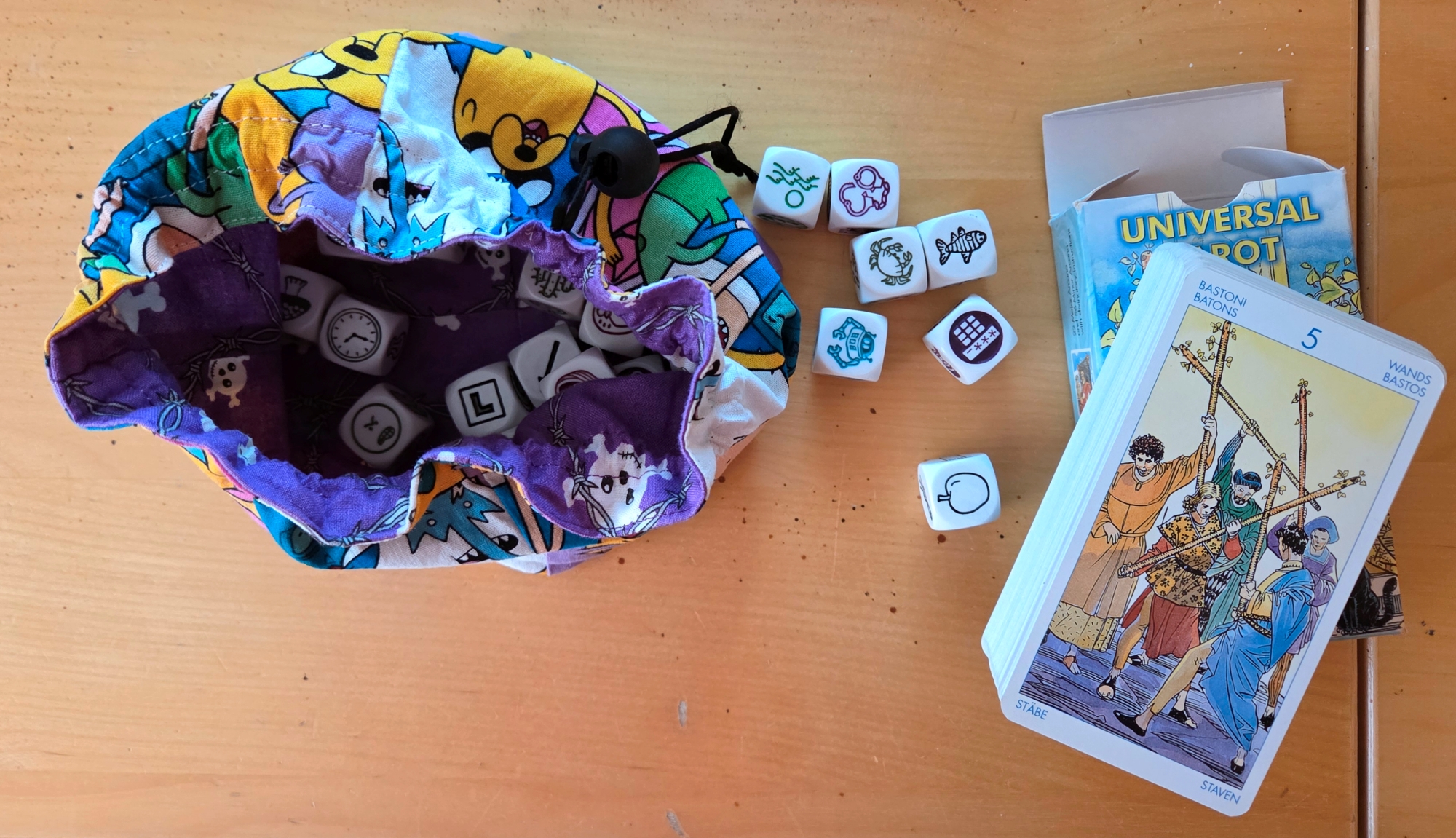
Story cubes:
- Grab three or four Story Cubes and roll them
- Use the first couple things that come to mind to add some depth to an NPC
- Ignore a die or two if they don’t fit
- Also works for situations/encounters
Tarot cards:
- Lay out three cards
- Upside-down means the opposite
- Use the first things that spring to mind to flesh out the situation, encounter, etc.
- Also works for NPCs
Updated to add: Tales of Argosa oracle dice
Added March 2026: Since I wrote this post, I’ve started using the oracle dice from Tales of Argosa in this campaign. They’ve become essential to me and have elevated the game.
They didn’t displace my Story Cubes and tarot deck, but a lot of situations where I was rolling Cubes or pulling cards are better served by using these oracle dice. “What’s this guy’s deal?” and “What’s happening in the jungle?” are great questions for the Story Cubes. “What’s this group up to?” and “Why did these folks show up?” are questions I like to resolve with tarot spreads.
But if it’s yes/no, and especially if the improv staples “Yes, and,” “No, but” and so forth are helpful, the oracle dice are fantastic. There’s some overlap (obviously, since I didn’t have the oracle dice before), and sometimes one tool might take the game in a different direction than another, but that’s all fine in my book.
I wrote a whole blog post about oracle dice.
Books of random patrons and NPCs
Supplement 7: 1,001 Characters and Supplement 1: 760 Patrons are my go-to books at the table. I also bring Supplement 13: Starport Encounters, but I don’t think I’ve actually used it yet.
Sometimes I roll randomly and see if the result makes sense. If I need a certain type of NPC, I go to the right section and pick one from there.
If a new NPC has even the slightest chance of being seen again, they go in the…
NPC card file
I think I started doing this when I ran first-edition Urban Shadows from 2017-2019. (No link for that one because I don’t support the publisher.) It’s a huge help in a sandbox game, where characters naturally accumulate over time and every NPC is a “toy” in our sandbox.
It’s just a pile of 3×5 index cards and a card case for them. For this campaign, I bought colored cards with matching tabs, and I file NPCs based on their relationship to the party (ally, enemy, etc.).
Each NPC gets a name, species, pronouns, pertinent stats or a reference to which character from Supplement 7: 1,001 Characters they are, at least one goal, and at least one big, broad personality trait. Over the course of play I jot other stuff down, then start using the back of the card, and then they become a proper mess — but they still work!
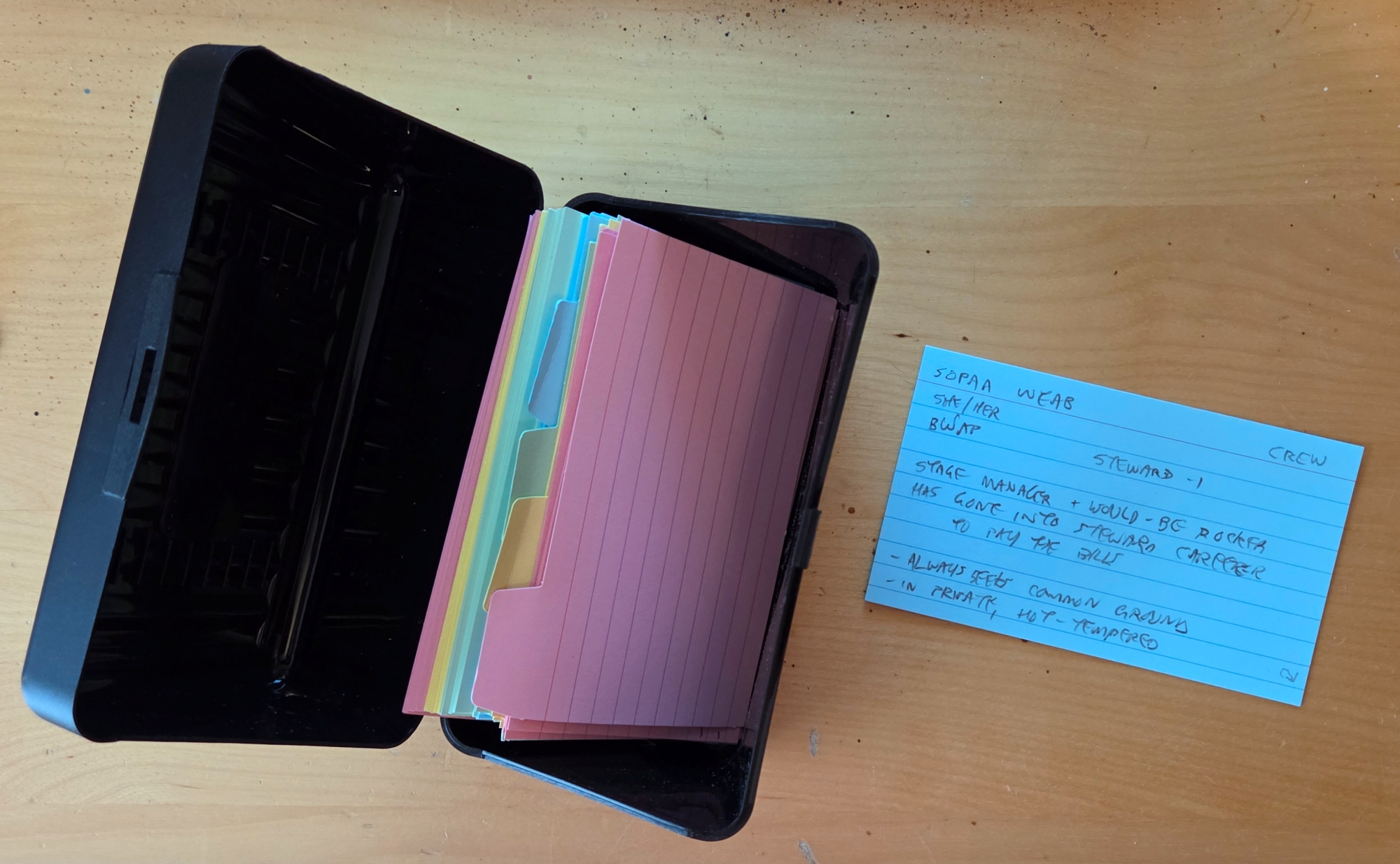
I also intended to write down locations and file them here, but I’ve been really bad about that. So far, we’ve seen multiple NPCs more than once but never returned to any locations, so it’s probably fine.
Rumor table
This excellent blog post on Stuffed Crocodile turns the rumor matrix found in some older Traveller modules into a d66 table. The author posits a logical next step, creating a custom version for each adventure/location, but I ignore that bit and just come up with the details on the fly (or between sessions).
When the PCs obtain rumors, the players roll a few times and I jot down the categories. It’s not hard to turn “Minor information,” “Misleading clue,” and “Important fact” into an adventure seed using the various tools I’ve described in this post.
Breaks
Breaks are one of the great tools of improv GMing.
Because there is no curtain, and therefore no reason to pretend I’m all-seeing, all-knowing, and have prepped everything ahead of time, when I need to make something up we all know that might take a few minutes and everyone’s fine with it.
Conversely, when the other players are strategizing or min-maxing the Neutrino Phoenix‘s cargo hold, that organically produces a break for me where I can make shit up.
Shared authorship
This sounds fancy, but it’s really just “Ask the other players lots of questions.”
For example, the campaign started on the planet Mortencen. I pulled up the library data and talked through it. Then we all came up with ideas for why, and how, it was how it was. Fifteen minutes later we had a fully sketched-out — and interesting — planet, and we spent a couple sessions there. It’s also someplace the party could easily wind up again, so apart from the pure fun of doing that we also invested in our shared sandbox.
Here’s the library data:

And here are the notes I jotted down based on our shared authorship of Mortencen:
- Balkanized = treaty for neutral starport control, point of contention
- Orbit is the fancy place to live
- System is also balkanized, access to the gas giant is restricted
- Tidally locked, everyone lives on the night side where it’s “only” 90f
- Mineral resources are on the day side, giant armored crawlers, balkanized
- Rusty red orange, red sandstorms on day-night line, lightning, Fury Road
- Lots of day/night themed stuff
- Tourist attraction = ceaseless, spectacular aurora borealis
- Unusual custom tech = no tech above TL11 allowed on planet, they are recovering from a high tech war
- They have scanners, bureaucrats, technical manuals, inspections, “bus lockers”
- Illicit business happens in tunnels or on dayside landings
- Aurora called Finger of God
- Treaty troops from all nations, grey East Berlin vibe
- Unusual custom nobility: assigned a minder in highport, a personal concierge
- Two space elevators
Thanks for reading
If you made it this far, I hope you got some good fuel for your own Traveller campaign, whether ongoing or forthcoming. Happy gaming!
This seems like it’d be so much fun. At the table, roughly what percentage of time do you spend on world-building together and exploring the narrative elements, versus the more crunchy parts where it’s more about the mechanics of the game (eg in combat)? And how does your group use the latter? As a skeleton for more narrative-driven play, or as it’s own thing, where the system, stats, and dice rolls take over for a bit? I’m asking because I’ve had trouble mixing both in games, getting them to mesh. Sometimes they’ve felt like two parallel lines. But sounds like you’ve got that working here
Oh dang, great questions!
The shared authorship vs. game mechanics split depends on the session. Last night is a good example.
When the party first arrived on the planet Dinajpur, we probably spent 30 minutes out of 2.5 hours on shared authorship of details. (The first time we did that, at the beginning of the campaign and with more to create, it was more like an hour.)
So last night, shared knowledge of the portion of the planet where they were already in place, was 100% other stuff. Skill rolls, some shooting (clearing jungle, blowing up tree-creatures), etc.
As to how we use combat, I like your description of parallel lines. We just use the game mechanics as intended, and layer in shared authorship and, in my case, improv GMing tools. We’re not really trying to turn Traveller into a different game, just adding things to it and altering the “behind-the-scenes,” meta portion of how it runs. Not sure I’m describing that well.
With a PbtA game, or a system closer to that, those parallel elements would be more thoroughly enmeshed with each other. But having them run in parallel, while it’s not as fluid, is working well for us.
“We just use the game mechanics as intended, and layer in shared authorship and, in my case, improv GMing tools. We’re not really trying to turn Traveller into a different game, just adding things to it and altering the “behind-the-scenes,””
I think I get the gist, yes. I can imagine that working really well with Traveller, especially that discrete bit of co-authorship whenever you visit a new planet.
Definitely an approach for me to come back to and reflect on when my group finishes our current campaign, see if we are up for experimenting with something similar. Thanks for the inspiration!
If you go down some version of this path, I’d love to hear about it.
Thank you, excellent post.
Thanks! I’m glad you enjoyed it.
Really inspiring stuff. I’m also a big fan of taking cues from other games, once you’ve identified the fantasy of your own campaign/adventure.
Thanks! I like nothing better than finding a tool from one game that applies well to others. It’s always a fun experience.